
Based in Port Orchard, WA
Excavation & Demolition Contractor in Kitsap & Pierce Counties
Above & Beyond Con handles excavation and site prep for residential and commercial projects. Whether you need a lot cleared, a foundation dug, a driveway graded or an old structure removed, our crew can handle the site work as a standalone job or as part of a larger build.
BUILDING & REMODELING
SINCE
2011
Local Businesses
Insured Businesses
Experienced Crew
Residential & Commercial
Request a Free Estimation
Groundwork for Every Project
Excavation & Demolition Services We Do across Puget Sound
From the first cut to the final grade, we get your property ready to build. Each service works on its own or as one step in a larger project.

Foundation & Basement Excavation
Excavation for new homes, additions, garages and basements, with the digging planned around the foundation layout and site access.

Site Preparation & Land Clearing
Clearing trees, brush and stumps to make room for construction, with removal and hauling of the cleared material.

Grading, Driveways & Building Pads
Shaping and leveling ground for building pads, gravel driveways and access roads, with a prepared base for the work that follows.

Utility Trenching
Trenching and backfilling for water lines, sewer connections and electrical conduit, working alongside the specialists installing the utilities.

Drainage & Footing Drains
Excavation for footing drains and drainage improvements to help move water away from foundations and areas that stay wet.

Demolition & Haul-Away
Removing structures, concrete and unwanted site features, then hauling away the debris to clear the space for its next use.

Retaining Wall Excavation
Excavation, grading and drainage preparation for retaining walls that hold back higher ground.
See Concrete Services →
LOCAL KNOW-HOW
Full Service Excavation Contractor
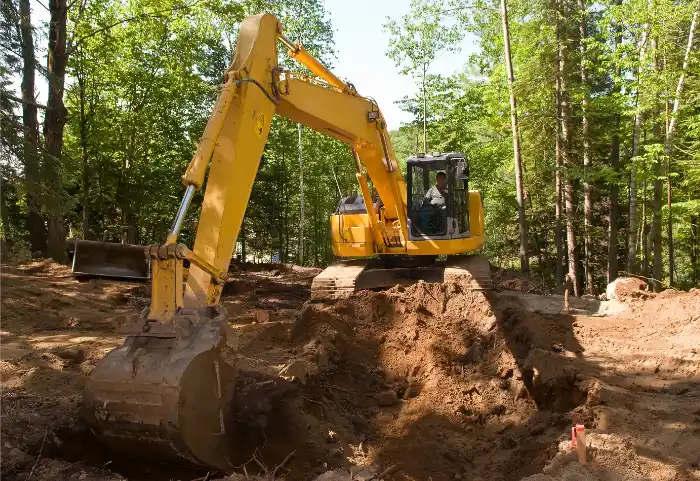
Above & Beyond Con provides excavation, demolition and earthwork across Kitsap and Pierce Counties, including Port Orchard, Bremerton, Silverdale, Gig Harbor, Tacoma and Wollochet. Our construction experience helps us prepare the site with the next stage in mind, whether that means accurate foundation cuts, a driveway base or grading around an existing home. Our experienced operators have worked through challenging Puget Sound conditions, including extensive tree roots, wet ground and sloped properties.
- Small jobs and larger site preparation
- Mini excavator for precise work in tight spaces
- Excavation, concrete and construction services
- Grading for driveways, patios and usable yard space
Contact us to discuss the technical details of your job, equipment access and what is possible on your property.
Frequently Asked Questions About Excavating
t depends on the amount of earth moved, the location and whether the work is covered by another construction permit.
- Unincorporated Kitsap County. Moving 150 cubic yards or more generally triggers grading review. Smaller projects can also need approval if they change drainage, create steep slopes or affect critical areas.
- Unincorporated Pierce County. County guidance identifies permit requirements for grading more than 50 cubic yards outside critical areas and more than one cubic yard within critical areas.
The volume can add up quickly. Lowering a 30-by-30-foot area by 18 inches removes approximately 50 cubic yards. Inside Port Orchard, Bremerton, Tacoma or Gig Harbor city limits, check with the city before applying county thresholds. See Kitsap County grading guidance · Pierce County fill and grade requirements
Start with the approved building location, finished floor elevation and access for equipment and deliveries. Site preparation typically includes clearing the construction area, removing stumps and organic topsoil, managing surface water and excavating for the foundation.
The work varies with the project. A garage may need a level building pad and a driveway approach. An addition requires careful excavation beside the existing foundation. A detached ADU may also need trenches across the property for utilities.
If excavation exposes soft ground, buried debris or old fill, the foundation designer or geotechnical engineer may need to specify additional work. Any required soil checks should happen before gravel, forms or concrete cover the excavated area.
Yes, when ground conditions, access and permit conditions allow it. Light rain may have little effect on a small excavation. Prolonged rain can saturate the ground, make truck access difficult and prevent fill from being compacted properly.
Wet-season work often needs smaller work areas, covered soil piles and erosion controls installed before digging begins. If equipment starts creating deep ruts or water collects in the excavation, the crew may need to pause or change the sequence.
Pierce County's stormwater guidance treats October 1 through April 30 as the wet season and requires faster stabilization of exposed, inactive soil. Build weather allowances into the schedule, particularly for larger clearing and grading jobs. See Pierce County construction stormwater guidance
Look at where the water comes from and what happens after the rain stops.
- Water running across the surface toward the house may be redirected by grading or a shallow drainage swale.
- Water pooling in a low spot may need a grade correction, a collection drain or both.
- Ground that stays wet after surrounding areas dry may indicate restricted drainage or seasonal groundwater that needs closer investigation.
The outlet matters as much as the collection point. Before installing a French drain or catch basin, establish where the water can safely and legally discharge. Raising one part of the yard can also push water toward another area, so the whole drainage route needs attention. See Washington State University drainage guidance
Usually, a new driveway needs some excavation to remove vegetation, topsoil and soft material before installing a compacted aggregate base. The depth depends on the existing ground, the finished surface and the vehicles using it. A driveway carrying an RV or delivery trucks may need different preparation from one used only by passenger cars.
If you are resurfacing an existing driveway with a sound base, the excavation may be limited. If it repeatedly develops ruts or soft spots, adding another layer of gravel may leave the underlying problem in place. Check the base and drainage first, including whether water can escape along the sides or through a culvert.See Federal Highway Administration gravel construction guidance
Private ownership does not remove permit requirements. The key questions are what you are changing, where you are digging and whether another permit already authorizes that work.
For example, Kitsap County allows certain footing and basement excavations under a valid building permit without a separate grading permit, subject to specific limits. Spreading the excavated soil elsewhere on the property can still need review. Changing an existing drainage course or working near a steep slope can also trigger approval requirements.
Before digging, request utility locates through 811. Some private lines, such as power to an outbuilding or irrigation piping, may need a separate locating service. Utility marking and permit approval are separate steps. See Kitsap County grading exemptions and Washington safe digging guidance
Start with the city or county demolition requirements and an asbestos survey by an AHERA-certified building inspector. Power, gas, water and sewer or septic connections also need to be disconnected or capped through the appropriate utility providers and specialists.
For structures with more than 120 square feet of roof area, the Puget Sound Clean Air Agency requires demolition notification even when the survey finds no asbestos. Its standard waiting period is 10 days after notification. Required asbestos work must be addressed before demolition begins.
Also confirm whether the permit includes foundation removal, backfilling and final grading. Pierce County requires approved utility capping, debris removal and completion of the applicable inspections. See Puget Sound Clean Air Agency demolition requirements and Pierce County demolition permit guide
The depth depends on the utility, its installation method and the provider's specifications. Cover is measured from the finished ground surface to the top of the pipe or conduit. The excavation must be deeper to accommodate the pipe and any required bedding.
- Electrical and gas trenches follow the utility provider's approved details.
- Water lines need the required burial depth and separation from other utilities.
- Gravity sewer lines must maintain the required slope between connection points, which can make one end considerably deeper.
There is also room needed around the trench. Washington guidance requires excavated soil and equipment to remain at least two feet from the edge. The opposite side needs sufficient space for safe access and the installation method. A narrow trench can therefore require a much wider working area, especially where sloping or shoring is needed. Confirm the route and specifications before excavation. See Puget Sound Energy construction resources and Washington trench safety guidance
Excavation Services Area
Kitsap County: Port Orchard · Bremerton · Silverdale
Pierce County: Gig Harbor · Tacoma · Wollochet
King County: Mercer Island
Serving all communities throughout Kitsap and Pierce County, with select projects in nearby counties as well.
Other Construction Services

Custom Build

ADU BUIlder

Home Addition

Painting